
Why Your Face Looks Older When You Lose Weight

You’ve put in the work. The number on the scale has shifted, your clothes fit differently, and by every measure, you’re healthier. So why does your face look more tired, drawn and somehow, older than before?
Losing weight can be one of the most positive steps you can take for your long-term health. But there is sometimes a trade-off where your face appears more “gaunt” than before. It is a frustrating paradox, and a more common one than most people expect. Here’s why looking older when you lose weight happens, and what you can do about it.
Weight loss does not cause an ageing face. It can, however, make age-related volume loss more noticeable and happen sooner in the face.
Unlike the abdomen or thighs, facial fat is not arranged as one continuous layer. It sits in distinct compartments called fat pads, across the cheeks, temples, and under-eye area. These compartments are relatively small and shallow, so volume loss becomes visible more quickly and often more unevenly, than elsewhere on the body.
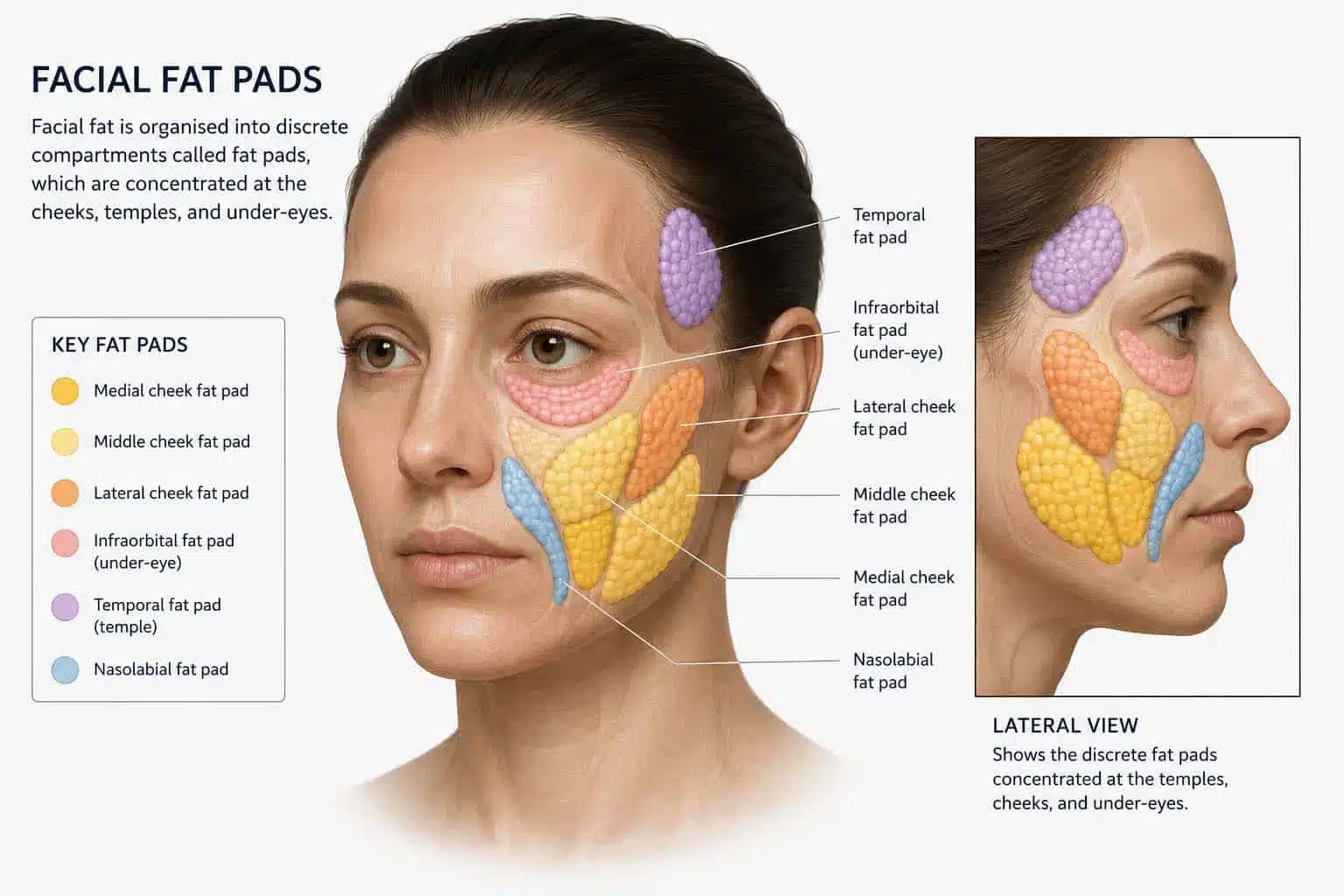
These fat pads maintain the face’s three-dimensional shape: cheek fullness, a smooth transition from under-eye to mid-face, and gentle contours through the lower face. When they shrink, the result is not just a slimmer face, but a structurally different one: more hollow at the temples, more defined in the folds around the nose and mouth, and less supported overall.
Two things keep a face looking youthful: volume –the fat pads and deeper soft tissues that provide structure– and firmness, the collagen and elastin that keep skin resilient and supported.
Weight loss primarily affects volume, and with rapid weight loss, the skin may not have enough time to adapt to the changes happening beneath it.
Think of the face like a cushion, where fat is the filling and collagen is the fabric. Remove the filling, and the fabric does not automatically tighten to match. Instead, it can fold, sag, and settle. That mismatch between reduced support and skin that is already ageing is what can create a gaunt or hollowed appearance after significant weight loss.
Fat loss is also only one part of the equation. Age-related ligament laxity, bone resorption, muscle volume loss, and declining skin quality and hydration can all reduce facial support. When weight loss occurs alongside these changes, facial hollowing, sagging, and contour changes may become more noticeable.
Lifestyle habits will not reverse volume loss, but they can support the skin and slow its progression over time:
These measures help, but they have limits especially if the issue is structural. In these cases, treatments are needed to address the loss of facial support.
As fat pads shrink, the skin has less support beneath it, which is why the face can begin to appear looser, flatter, or less defined over time. This is where face lifting treatments can play a role – not by replacing lost volume, but by helping the skin maintain firmness and adapt more effectively as the face changes.

Energy-based lifting treatments, including HIFU, Ultherapy Prime, Sofwave, and Ultraformer MPT, work by stimulating collagen within the skin and deeper support structures, including the SMAS layer — the connective tissue responsible for facial firmness and lift. By promoting collagen renewal, these treatments help improve skin firmness, support facial contours, and maintain skin quality during and after weight loss.
A common concern is whether these treatments can cause additional facial fat loss. When performed correctly, they should not. The goal is collagen stimulation, not fat reduction. Unwanted fat loss occurs only when treatment is performed incorrectly, such as using the wrong settings or depth, or when too much energy is delivered into fat layers by an inexperienced provider.
For effective lifting, treatment should be directed at the SMAS and other support layers rather than the fat layer. Proper treatment planning helps ensure the focus stays on skin tightening and support rather than fat reduction.
If you are already experiencing lost volume, Hyaluronic acid (HA) fillers and collagen biostimulators can replenish volume in areas such as the cheeks, temples, and under-eyes.
Timing also matters. Starting treatment during a weight loss journey, rather than waiting until laxity becomes more established, allows the skin to build firmness gradually as facial volume changes.
A slimmer body and a youthful-looking face are not mutually exclusive. Weight loss remains one of the most meaningful things you can do for your long-term health, but the face may need additional support along the way. As facial volume changes, maintaining skin firmness, collagen quality, and structural support can help the face adapt more gracefully.
If you’re exploring your options and want an honest assessment of what your skin needs, book a consultation at SL Aesthetic Clinic. We will provide personalised care and a treatment plan to help you achieve your aesthetic goals safely.
Like what you read? Share them!


Not sure if this treatment is right for you? Speak with our team in a no-obligation consultation, and view real patient results.