
Why Asians Age Differently – The Sinker, Sagger, Wrinkler Framework

You’ve probably come across the ‘sinker, sagger, wrinkler’ framework – the idea that our faces age in three distinct patterns. However, the framework was largely developed from research on Caucasian facial anatomy.
Asian faces – including Chinese, Malay, and Indian skin types that make up the majority of patients in Singapore– age differently due to factors like bone structure, fat distribution patterns, skin thickness etc.
This article will explain the specific signs to look for to determine the way your face ages, provide an honest self-assessment guide and the treatment choices you have.
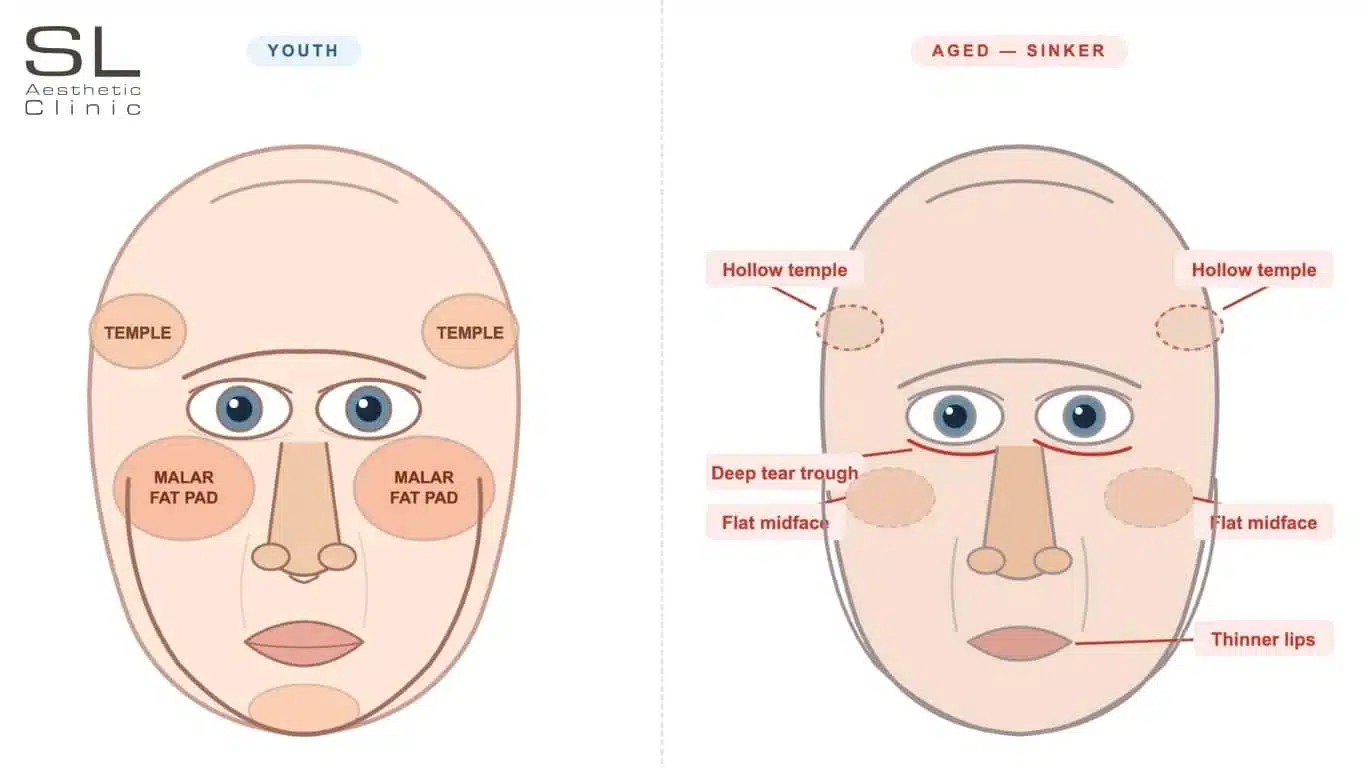
Sinking happens when the structural scaffolding of the face loses mass. This includes bone resorption (the facial skeleton actually shrinks with age), fat pad atrophy (the natural fat compartments of the face deflate), and muscle thinning.
What sinking looks like:
The sinker’s face often looks ‘gaunt’ or ‘tired’ rather than ‘old’. People may tell you that you look exhausted even when you’re not, or that you look like you’ve lost weight (even if you haven’t).

Sagging happens when the structural ligaments and support systems that hold facial tissue in place weaken and elongate.
Your fat pads migrate downward and inward and the SMAS layer –an important layer in face lifting– loses tension. The sagger doesn’t necessarily lose volume overall; the tissue is still there, just in the wrong place. This is a fundamentally different problem from sinking, and it requires fundamentally different treatment.
What sagging looks like:

Wrinkling happens when the skin itself ages; collagen and elastin fibres break down, hyaluronic acid depletes, and the dermis loses its ability to rebound and stay smooth, resulting in lines and a change in the skin’s quality.
Wrinkling typically manifests in two ways – dynamic wrinkles ( e.g. crow’s feet, forehead lines, frown lines caused by repeated muscle movement) and static wrinkles (present at rest, caused by structural skin ageing).
What it looks like:
| THE SINKER | THE SAGGER | THE WRINKLER |
|---|---|---|
| Primary: Volume loss | Primary: Tissue descent | Primary: Skin quality |
| Hollow temples and cheeks | Jowl formation at jawline | Fine lines at rest |
| Deepened tear troughs / under-eye hollows | Nasolabial folds from cheek descent | Crepey skin texture |
| Flatter cheekbones over time | Heaviness in lower face | Crow’s feet and forehead lines |
| Thinning of lips and chin area | Drooping brow and upper eyelid | Rough or uneven skin surface |
| More prominent nose (relatively) | Jowl “marionette” lines | Loss of skin luminosity |

Several studies suggest that Caucasian skin tends to develop wrinkles and laxity earlier. However, due to differences in facial structure and volume distribution, signs of ageing in Asian faces can sometimes appear more pronounced when they occur.

Asian faces typically have a flatter, more recessed midface compared to Caucasian faces, with less bony projection in the cheekbones and orbital rims. With less bony scaffolding to maintain soft tissue position, the ligaments have less structural support, meaning that when they weaken with age, tissue descends faster and further than it would in a face with greater bony projection.
The initial sinking also tends to appear more pronounced in the temples and periorbital area, precisely because there was less bony prominence to begin with. For the same reason, volume restoration in Asian patients often needs to address the structural level first –replacing deep fat and supporting bone-level volume– before working on the more superficial fat compartments.
Asian skin (Types III–V on the Fitzpatrick scale) is generally thicker and more melanin-rich than Caucasian skin.
Wrinkles appear later and Asian women often look 5-10 years younger than Caucasian counterparts at the same age when measured by skin surface quality alone.
However, when the structural aging (sinking and sagging) does begin, it usually happens at an accelerated pace, especially between ages 40-50.
In Caucasian faces, the malar fat pad sits higher and more laterally while in Asian faces, it tends to sit more medially and lower from the outset, which produces a distinctly different sagging pattern as it descends with age.
Rather than the angular jowling at the jawline that is the hallmark sign in Caucasian saggers, Asian patients more commonly develop a fuller, heavier central face as the malar fat pad migrates further inward and downward.
This means that treatment approaches targeting lateral lifting (common in techniques designed for Caucasian faces) can actually pull the wrong vector on Asian faces, creating an artificial lateral pull rather than a natural midface elevation.
Many East and Southeast Asian patients have stronger masseter muscles (the jaw-clenching muscles at the sides of the face) due to dietary and genetic factors. This creates a wider, squarer lower face that affects how sagging appears; a wide masseteric base can make jowl formation look more severe than it is in terms of tissue descent.
Anti-Wrinkle Treatment to slim the masseter is often part of a complete rejuvenation protocol for Asian saggers.
The following self-assessment can help you identify your dominant pattern.
Note: this is a guide, not a diagnostic tool – your doctor will assess the full picture including bone structure, fat compartment position, and skin quality in person.
| What You See / Feel | Likely Sinker | Likely Sagger | Likely Wrinkler |
|---|---|---|---|
| Look down — what gathers under your chin? | Fat pads shift, hollows appear on face | Jowl tissue drops clearly | Neck skin creases |
| Lift cheeks gently upward — does face look better? | Somewhat — but still hollow | Yes, significantly | Slightly — lines remain |
| Photos from 10 years ago — main difference? | Face looks flatter, less defined | Heavier lower face, less jaw definition | Skin texture and fine lines |
| Do you notice change when lying down vs standing? | Minimal change | Face looks younger lying down | Similar both ways — lines remain |
| Where is your skin thinnest? | Around eyes and temples | Cheeks and lower face | Crow’s feet, forehead, upper lip |
You’ll likely find yourself in a few categories – this is because almost nobody is purely one type. After 40, most people experience all three types of aging simultaneously but to varying degrees.
For example, a 42-year-old patient might be 60% sagger, 30% sinker, and 10% wrinkler. A 55-year-old might be more evenly distributed.
For treatment to be effective, it’s important to address the most dominant ageing pattern first, then layer treatments for the secondary patterns. This is why treatments for saggy skin often involve a combination approach, targeting different concerns in a structured sequence for the best results.

The following treatments are available at SL Aesthetic Clinic and are chosen based on the dominant ageing pattern identified at consultation. For most patients, a combination approach is recommended.
Below, a guide but not confirmative of treatment as a doctor’s consultation is required.
| Treatment | Best for Asian Ageing Pattern | Addresses | Downtime | Longevity |
|---|---|---|---|---|
| Dermal Fillers | Sinker (primary) | Volume replacement, structural support | Minimal | 12–18 months |
| HIFU / Ultraformer MPT | Sagger (primary) | Tissue lifting, SMAS tightening | None–low | 12–18 months |
| RF ThermaLift / Thermage | Sagger + Wrinkler | Skin tightening, mild lifting | None | 12 months |
| RF Gold Microneedling | Wrinkler + mild Sagger | Collagen remodelling, texture, pores | 2–3 days | 9–12 months |
| Anti-wrinkle Treatment | Wrinkler (dynamic lines) | Muscle relaxation, line prevention | None | 3–4 months |
| 6D Laser Facelift | Sagger + Wrinkler | Multi-layer lifting and resurfacing | Low | 6–12 months |
| Skin Boosters (HA/PN) | Wrinkler + Asian hydration needs | Skin quality, hydration, glow | None | 3–6 months |
| Sofwave™ | Sagger + early Wrinkler | Mid-dermis collagen stimulation | None | 12 months |
| Fat Grafting / Biostimulators | Sinker (significant loss) | Deep volume, natural integration | 3–5 days | 2–3 years |
The sinker, sagger, and wrinkler framework is a useful tool, but only when applied with an understanding of how Asian facial anatomy modifies each pattern. The right treatment approach accounts for all of this – not just which pattern you are, but what proportion of each, and how your specific facial anatomy shapes the way each pattern shows up.
At SL Aesthetic Clinic, our doctors assess all of the above at consultation and design protocols that address your specific combination of patterns in the right sequence. Book a consultation to understand your own ageing picture, and what it actually takes to address it.
References:
Like what you read? Share them!


Not sure if this treatment is right for you? Speak with our team in a no-obligation consultation, and view real patient results.